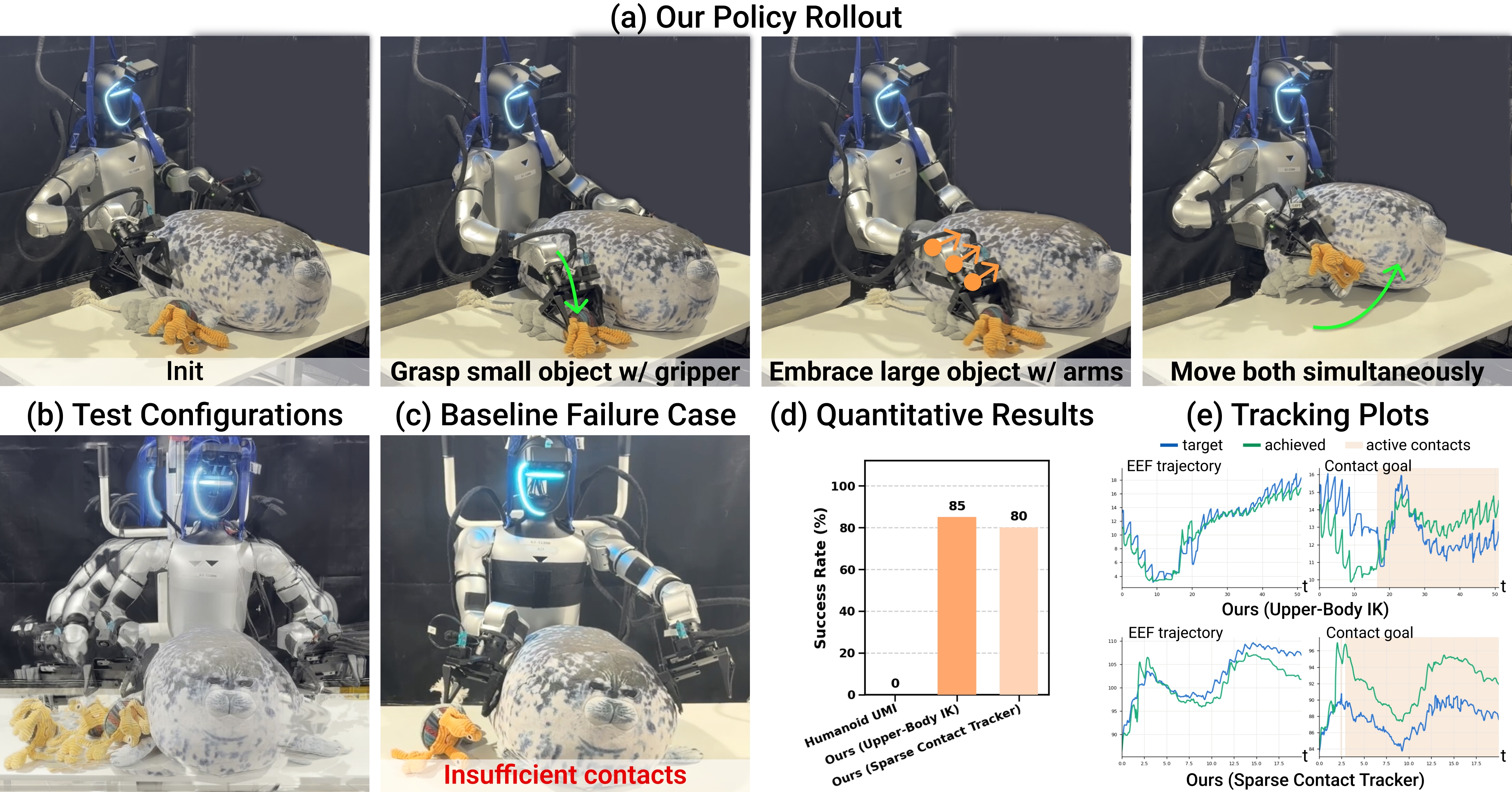
A person carrying a bulky object uses forearms and torso as well as fingers. A humanoid policy that learns only hand trajectories can miss the contacts that actually support the load. PanTact asks whether those contacts can become an explicit teaching signal.
The October 8 preprint uses a wearable human demonstration interface to record contact alongside vision and motion. A learned policy predicts contact goals, and a controller realizes them on a Unitree G1. The robot need not reproduce every human joint position to preserve the useful interaction. Primary source.
Contact is a goal, not a copied pose
This distinction matters because a robot and a demonstrator have different proportions. Matching the hand location can leave the robot’s forearm in the wrong place. A contact objective instead specifies which interaction must occur while allowing the controller to choose a feasible body configuration.
The paper tests three task families. In grasp-and-embrace, one configuration succeeds in 17 of 20 rollouts. Carry-and-push succeeds in nine of ten. Sweep-and-stow uses a composed score that awards partial credit for cabinet closure; its reported percentage must not be treated as the same binary success measure. These are research evaluations, not shift-long operating records. Primary source.
The next test is broader contact variation
For researchers, the immediate contribution is a way to separate useful contact information from the incidental pose of a demonstration. For deployment teams, an open question remains: how reliably can the system recognize that a contact is slipping, obstructed or unsafe?
Broader objects, different surface friction and repeated recovery trials would show whether this representation reduces task-specific engineering. A good next comparison would preserve the evaluation conditions and report complete outcomes alongside partial-credit scores.
The source figure is reproduced unchanged under CC BY 4.0; attribution appears in the image caption.
Sources & evidence
Sources describe the announcements and evidence available when this analysis was published. Company claims are attributed; plans and trials are not treated as sustained operation.