A humanoid controller can track its intended motion accurately on level ground yet lose its footing on a slope. The available friction and contact geometry have changed, so the controller’s priorities may need to change too.
In a September 28 open-access study, Hongtao Zhang, Lan Wu and Thomas Bräunl describe a terrain-adaptive controller using joint encoders and an inertial measurement unit. It estimates local terrain orientation and adjusts whole-body optimization weights rather than relying on a camera or terrain-specific manual tuning. Primary source.
The comparison is between control strategies
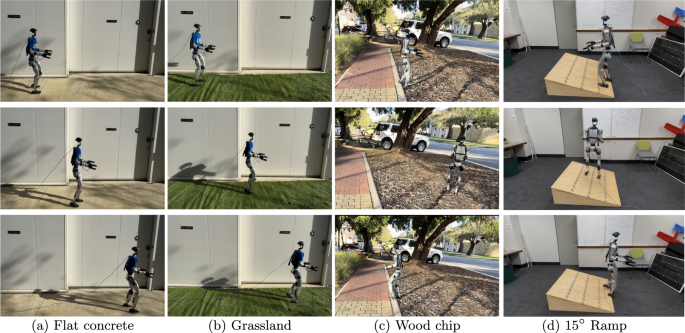
In simulation, the adaptive controller traverses a ten-degree ramp where the tested fixed-weight baseline falls. Physical Unitree G1 experiments include concrete, artificial grass, wood chips and a fifteen-degree ramp. These are bounded demonstrations of the proposed method, not evidence that arbitrary outdoor terrain is solved. Primary source.
The paper also shows failures at a step and on a twenty-degree ramp. Internal sensing only learns about a discontinuity through the robot’s interaction with it; it cannot necessarily provide the advance warning that a visible obstacle requires. Primary source.
Adaptation and anticipation solve different problems
The practical lesson is to evaluate what information is available before contact and what can be inferred afterward. A simpler sensing stack may handle continuous slopes while still needing another mechanism to identify an abrupt hazard.
For future systems, this controller could be one layer in a broader design rather than a replacement for every external sensor. More repeated tests across friction conditions, surface transitions and recovery attempts would clarify where the method’s useful operating envelope ends.
The source figure is reproduced unchanged under CC BY 4.0; attribution appears in the image caption.
Sources & evidence
Sources describe the announcements and evidence available when this analysis was published. Company claims are attributed; plans and trials are not treated as sustained operation.