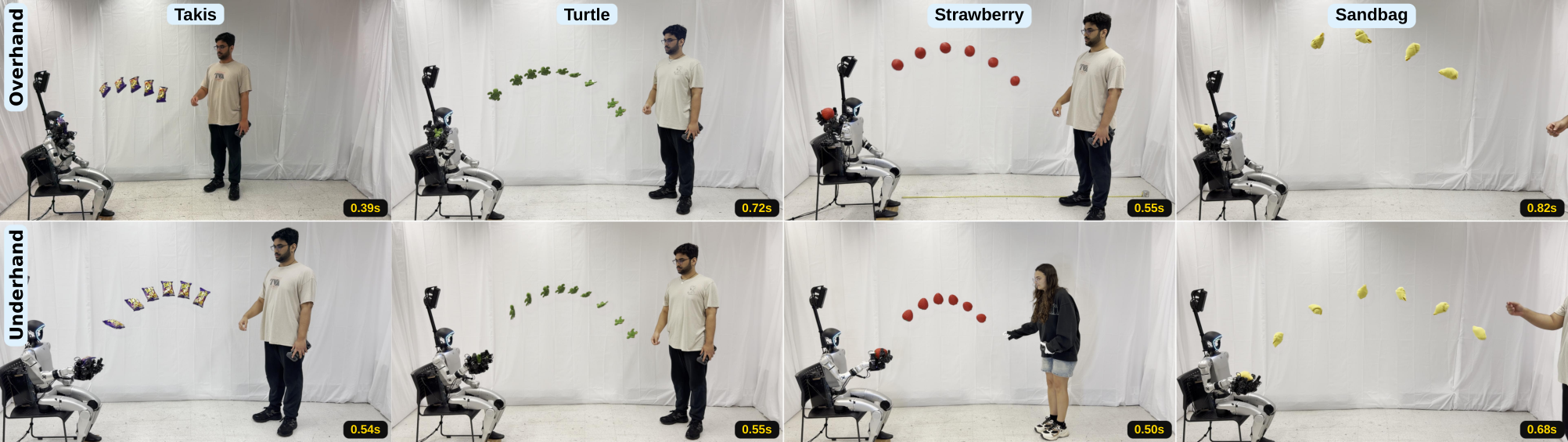
Catching is unforgiving: a hand must arrive at the right place and adapt to contact before an object rebounds. Demonstrating the motion with one familiar ball leaves a larger question unanswered—whether the controller can cope with a different shape or material.
The October 28 Catch It All preprint addresses that question with a simulation-trained policy deployed on a Unitree G1. The authors report underhand and overhand catches across nine previously unseen objects using one egocentric camera. The test objects include soft and rigid items with different contact behavior. Primary source.
Object variation changes the control problem
The approach uses a training curriculum and grasp rewards to learn when and how to close the hand. The paper also considers hardware torque limits. These are useful design constraints because reacting faster is not automatically an improvement if the resulting command overstresses a joint. Primary source.
The photographs show research trials, not an independently tested industrial catching system. Most importantly, the authors explicitly say the framework does not control the whole body. A successful hand catch therefore cannot establish that a freely moving humanoid would remain balanced while making the same response.
The body remains part of the task
For manipulation researchers, the contribution is evidence that contact variation can be incorporated into sim-to-real training. For operators, useful capability would require a defined incoming-object envelope, unsuccessful-trial accounting and a safe response to missed catches.
If future work combines the hand policy with validated balance control, the reachable catching region might expand. The next decisive result is a repeated whole-body evaluation with object, trajectory and speed conditions reported—not a more dramatic single throw.
The source figure is reproduced unchanged under CC BY 4.0; attribution appears in the image caption.
Sources & evidence
Sources describe the announcements and evidence available when this analysis was published. Company claims are attributed; plans and trials are not treated as sustained operation.