Stopping a machine can require another controlled movement. A humanoid may need powered joints to remain balanced, and moving toward a resting posture can create a collision if a person, object or work surface is in the way.
CMU’s September 28 account of research with Siemens highlights that problem. The underlying March preprint describes PRISM, a learned monitor that estimates whether a particular fallback controller can reach a minimum-risk state from the robot’s current condition. CMU account.
The stop has an operating envelope
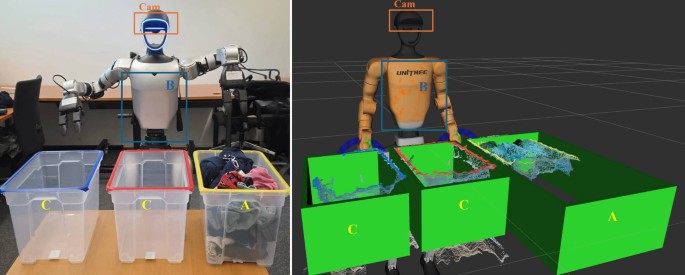
The study uses a Unitree G1 performing a defined pick-and-transfer task. Simulation supplies safe/unsafe labels for fallback rollouts, while physical trajectories and augmented-reality reconstruction help connect the monitor to hardware. Unsafe physical collisions are not the test method. Research method.
This makes the safety question conditional: can this fallback policy stop this robot safely in this state? A positive result is not a general safety certification or proof that every possible stop remains safe.
A posture is only part of a stopping procedure
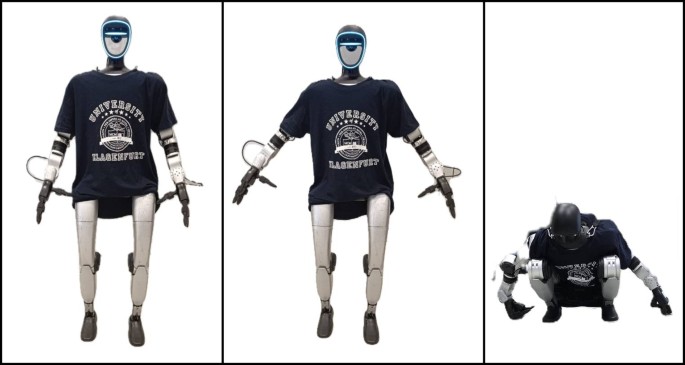
The accompanying image shows proposed postures from a separate October textile-sorting study, not PRISM experiments. It illustrates why an endpoint must be distinguished from the path used to reach it. Both require validation. Image context.
The immediate engineering value is to examine the fallback controller alongside the nominal task controller. Before broader use, operators need false-safe rates, tested environmental limits and a response for uncertain states. Changing the payload, nearby geometry or fallback policy should trigger renewed evaluation rather than inheriting confidence from a previous configuration.
Source figure reproduced unchanged under CC BY 4.0.
Sources & evidence
Sources describe the announcements and evidence available when this analysis was published. Company claims are attributed; plans and trials are not treated as sustained operation.