Noitom Robotics’ ITW-Ego Plus is a useful addition to the market for humanoid training data. A first-person video can show what someone saw while leaving out how the person reached, shifted position or interacted with the surroundings. Pairing that view with movement data makes the recording more informative, provided the signals remain aligned and their limits are clear.
In its November 5 announcement, Noitom introduced Ego Plus alongside its Sol headset and Jupiter wearables. The company describes a modular offering that can add body motion, wrist views, external views, touch and sound to egocentric video. At the upcoming event, the announced demonstration focuses on body capture. The optional modalities should not be assumed to exist in every sample.
That distinction is commercially important. A team buying data needs a description of the actual delivered configuration, including timestamps, calibration, missing signals and the conditions under which the recording was collected. A product family name is not a substitute for that contract.
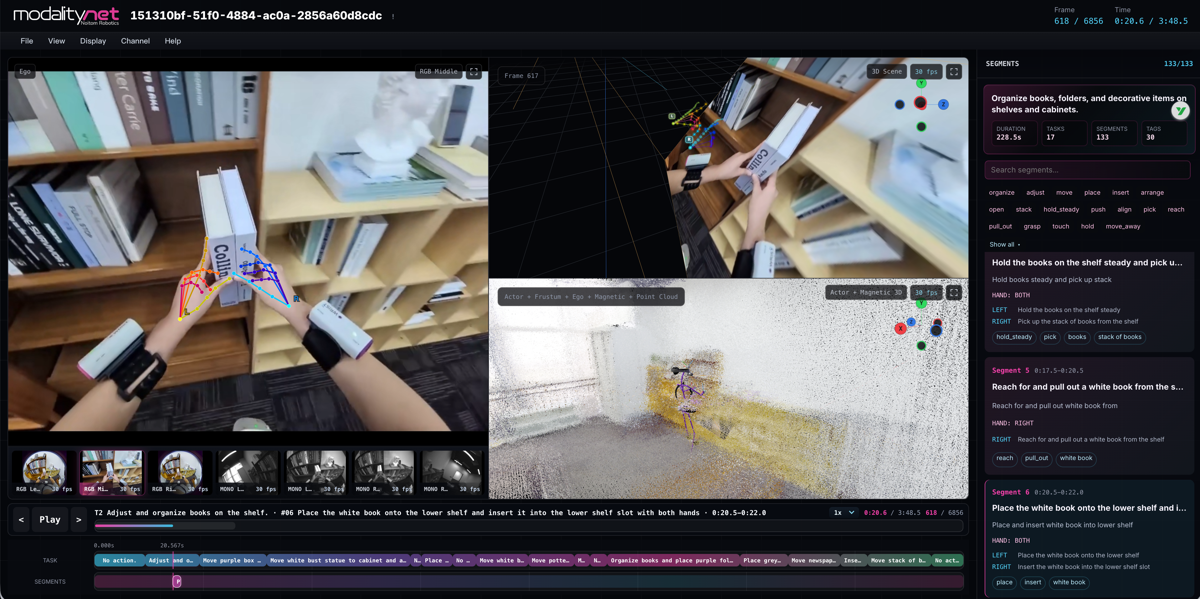
The company’s accompanying viewer image shows a book-organizing task through first-person video, reconstructed spatial views and labeled segments. Those synchronized perspectives can help a developer interpret an action. The image is an example of the data interface, rather than proof that a humanoid learned the task or performed it reliably.
The strongest counterargument is that human movement data still leaves a translation problem. A robot may have a different reach, balance constraint or contact surface. Capturing more of the person’s movement reduces missing context, but it does not determine which actions a particular machine can safely reproduce.
A practical evaluation should therefore start with a defined robot task and examine whether the additional signals change the result. Buyers can compare the usable coverage, alignment and correction effort against a simpler video-only dataset, then test any resulting policy on held-out physical cases. The added modality earns its cost through that outcome.
In the near term, Ego Plus gives teams another way to specify richer recordings without treating every capture as identical. Longer term, well-described multimodal data could make humanoid development less dependent on one-off collection efforts. The important advance is usable, inspectable context—not simply more hours of footage.
Sources & evidence
Sources describe the announcements and evidence available when this analysis was published. Company claims are attributed; plans and trials are not treated as sustained operation.