Learning from human activity is attractive because it could reduce the robot demonstrations required for each new task. LiberAI’s November introduction of Liber-0 makes that proposition concrete enough to examine through a defined company-run evaluation.
The company reports 36.0% overall success across 600 trials on 60 tasks proposed by GPT-6. The evaluated checkpoint had not trained on robot demonstrations collected specifically for those target tasks. The results are the company’s experiments, not an independent certification of general capability.
The split is substantial: reported success was 63.5% for pick-and-place, 34.0% for short non-pick-and-place manipulation and 10.5% for challenging multi-step tasks. Those figures describe complete task success in this suite; they should not be confused with the progress scores reported in separate internal benchmarks.
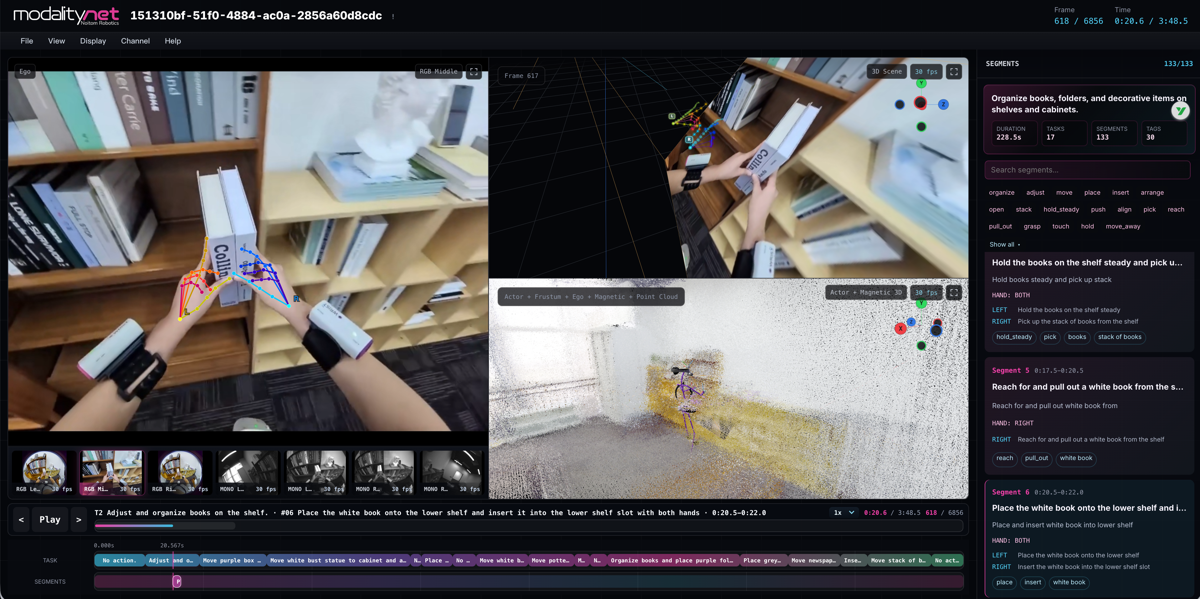
The underlying approach combines human visual experience with measured motion from gloves and explicit information about the body executing an action. LiberAI also aligns the LEO robot’s observations and motion with human recordings. The important engineering idea is to connect what a person sees with actions a particular robot can execute.
Task-level zero-shot has a precise limit here. It means the target task lacked its own collected robot demonstrations, not that the model had no robot-related training, no relevant human experience or no dependence on a suitable physical configuration. Removing those qualifications would make the result sound broader than the experiment supports.
For an operator, the low multi-step completion rate is consequential. A sequence can fail even when most individual movements look plausible. Evaluation should record which step fails, whether the system notices and what human assistance is needed to resume without damaging an object or losing task state.
Near term, the release supplies a testable account of human-to-robot transfer and its uneven boundaries. Longer term, the commercial question is whether the same approach reduces total data and recovery work on customer tasks. That requires reproducible evaluations on new objects, environments and operating conditions, beyond selected successful demonstrations.
Sources & evidence
Sources describe the announcements and evidence available when this analysis was published. Company claims are attributed; plans and trials are not treated as sustained operation.