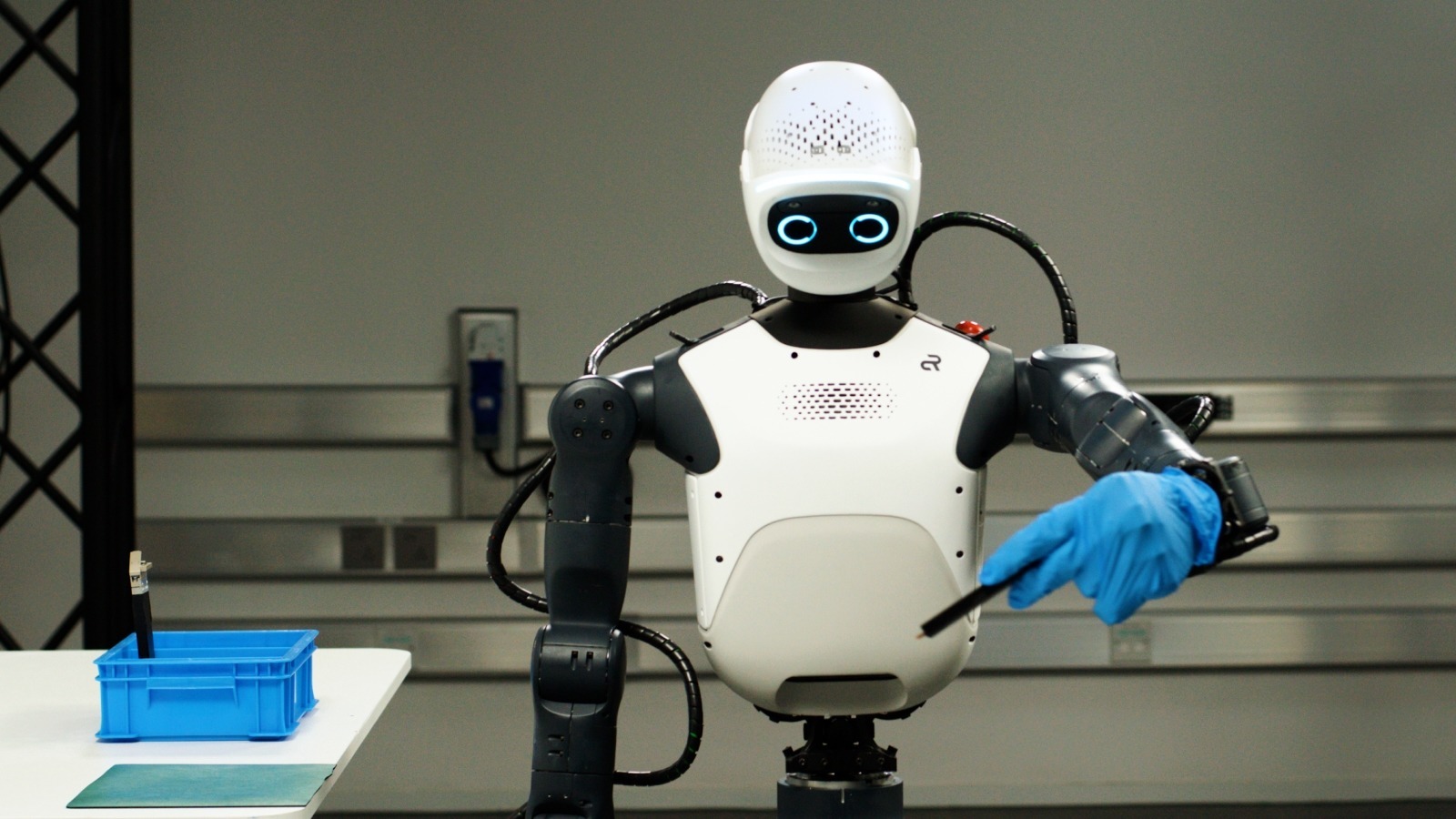
A humanoid handling laundry must remember what it moved even when an item disappears behind a door or another object. NEURA Robotics' Neuron AI launch addresses that continuity problem by combining several senses and memory in a shared robot model.
NEURA introduced Neuron AI on October 14. The company describes a perception-language-action architecture joining vision, touch, audio, robot state and language, trained across five of its robot embodiments. Those are the supplier's architectural and coverage claims; they are not a published comparison of task reliability against other systems. NEURA's launch account.
Remembering a task requires more than recognizing an object
A camera frame can identify a garment without establishing whether a grasp held or whether a previous step succeeded. Contact and sound can add evidence, while memory can preserve state between observations. The engineering opportunity is to keep the action policy informed when a single sensor becomes ambiguous.
NEURA says training combines robot interaction data, simulation and human demonstrations. Customers can fine-tune skills and distribute them through Neuraverse, with private skills remaining private. The commercial proposition therefore includes an adaptation and distribution workflow, rather than only a model that issues movements.
The unit of progress is a dependable new skill
The launch notice scheduled an eleven-minute 4NE1 laundry demonstration for GTC Berlin, October 20–22. It described the intended sequence and absence of intervention, but that advance notice alone does not verify how the demonstration subsequently ran. It supplies neither repeated trials nor failure rates across different laundry loads. Demonstration scope stated before the event.
For an operator, a model's range matters only if a new task becomes repeatable without excessive setup. Evaluation should count failed grasps, interrupted sequences, resets and human assistance alongside completed cycles. Faster adaptation would be valuable; silently excluding troublesome items would produce a different result.
NEURA calls time-to-skill its central measure. That is a useful direction if the endpoint includes a defined reliability requirement. The next evidence to watch is an account of training effort and repeated physical outcomes at customer sites, showing whether multisensory memory reduces the time and support needed to obtain a dependable task.
Sources & evidence
Sources describe the announcements and evidence available when this analysis was published. Company claims are attributed; plans and trials are not treated as sustained operation.