A humanoid working beside traffic police is operating inside a human service, not simply completing a motion demonstration. DEEP Robotics’ account of the Hangzhou Marathon is therefore most useful when read through its division of responsibility: repetitive guidance and monitoring for the machine, consequential judgment and intervention for officers.
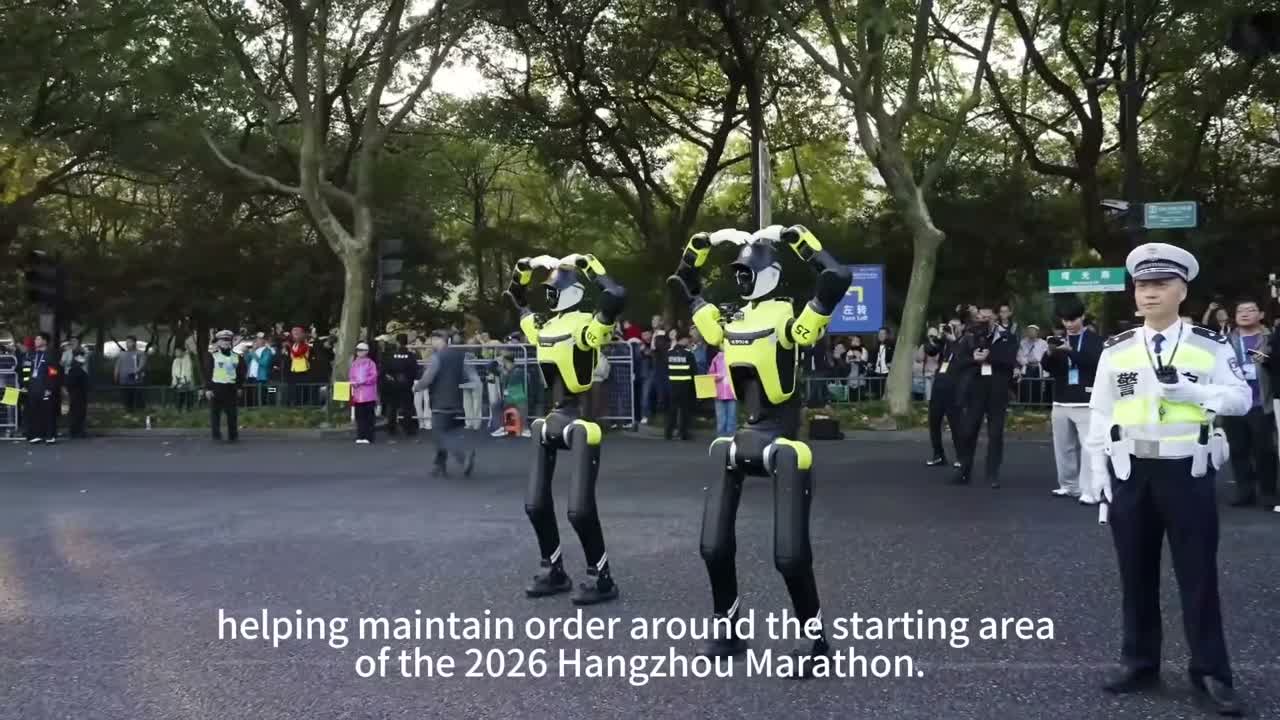
In a November 8 release, the company reported deploying humanoids at four locations around Huanglong Sports Center during the November 1 marathon. It described traffic guidance, public information and patrol support, with officers remaining responsible for complex incidents and emergencies. These are the manufacturer’s reported activities, not independently measured improvements in traffic safety.
The release describes patrols along predefined routes. It says the robot can stop or navigate around an obstruction and move to standby if a passage becomes impassable. Those boundaries are important because a public event can change faster than a planned route: people gather, access points become blocked and an ordinary inquiry can turn into an incident.
The accompanying manufacturer footage shows robots alongside officers and members of the public. It identifies the setting and visible interactions but cannot establish detection accuracy, the rate of remote intervention or performance across the entire event. Those require operational records rather than a selected montage.
A practical evaluation should follow the handoffs. Teams need to know when the robot requested assistance, what information reached an officer and how quickly a safe state was established. The quality of that process may matter more than whether a routine gesture or announcement can be repeated for a long period.
The strongest case for the deployment is that bounded, repetitive duties can support people working under concentrated demand. The limitation is that an event deployment does not automatically establish suitability for every street or crowd. Site layout, communications, supervision and the authority to change the operation all influence the result.
Near term, DEEP Robotics and the authorities say they will review the deployment and refine procedures. Longer term, a repeatable public-service role would require evidence that those procedures work when conditions depart from the plan. The marathon provides an operating setting for that evaluation, with human responsibility still central.
Sources & evidence
Sources describe the announcements and evidence available when this analysis was published. Company claims are attributed; plans and trials are not treated as sustained operation.